We've officially hit the era of "Peak Polish."
You know the look. You see it every time you open a social media app or browse a new landing page. It's that ultra-smooth, hyper-saturated, mathematically perfect aesthetic that AI creates in about four seconds. It's clean, it's professional, and increasingly, it's incredibly boring.
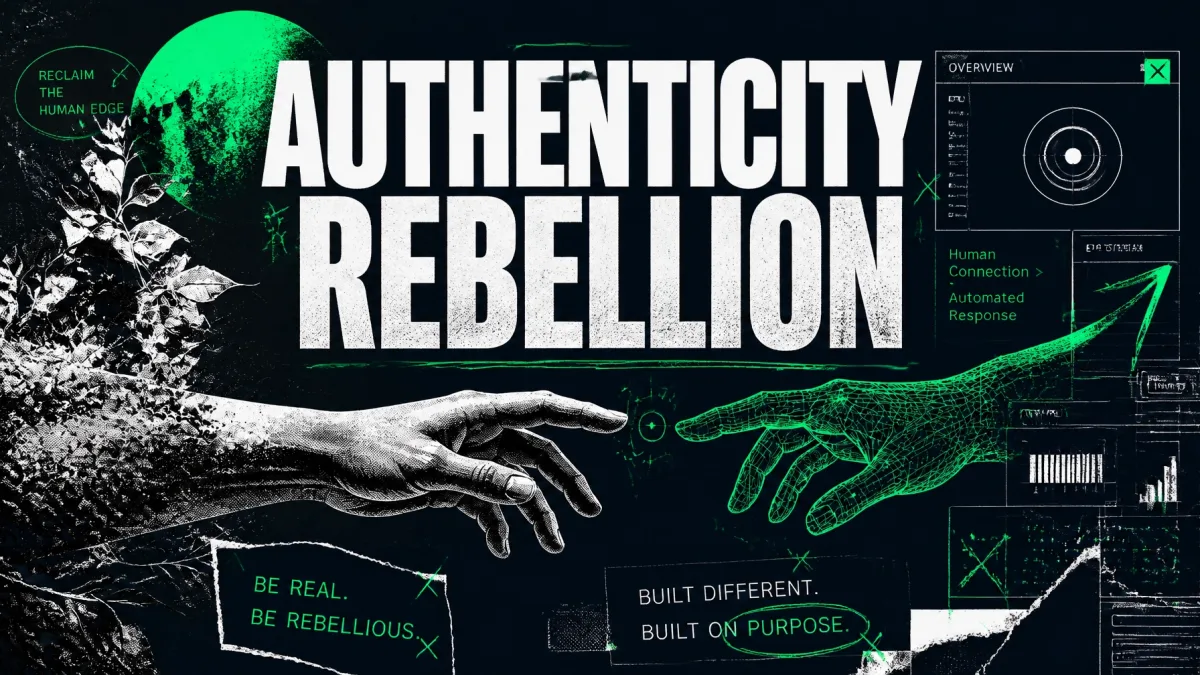
In a world where everyone has access to tools that generate "perfect" imagery, perfection has become a commodity. When everything is flawless, nothing stands out. This has sparked what we call the Authenticity Rebellion.
Clients are no longer just looking for "good" design; they are looking for design that feels real. They want soul, grit, and the unmistakable mark of a human hand. For freelancers and independent professionals, this is a massive opportunity.
The Uncanny Valley of Digital Perfection
There is a psychological concept called the "Uncanny Valley." Usually, it refers to robots that look almost human but are just off enough to make us feel uneasy. We are seeing a similar trend in brand design.
AI-generated art is often too balanced. The lighting is too consistent. The skin is too smooth. When a brand uses these visuals exclusively, they risk looking "expensive but empty."
In contrast, "imperfect" design, designs with film grain, slightly offset typography, or organic textures, signals to the human brain that there is a person behind the screen. It creates an immediate sense of trust. For a freelancer, selling this "humanity" is how you beat the race to the bottom on pricing.
Why 'Imperfect' is the New Premium
You might think that making things look a little rough around the edges would devalue your work. The opposite is happening. Research and market trends show that human-crafted, intentional design can command a 10x to 50x premium over generic AI outputs.
Why? Because authenticity is rare.
1. The Cinematic and Film Grain Aesthetic
There's a reason why Gen Z is obsessed with film cameras and why high-end brands are adding heavy grain to their digital ads. Film grain adds "noise." In the world of data, noise is usually a bad thing. In the world of emotion, noise is texture.
Cinematic aesthetics evoke nostalgia. They feel like a memory rather than a render. When you use these elements in a client's brand identity, you aren't just giving them a logo; you're giving them a mood. You're giving them a "vibe" that people want to belong to.
2. Human-Centered Branding
AI is great at following instructions, but it's terrible at understanding context. It doesn't know why a specific shade of "off-white" feels like a cozy coffee shop in Berlin while a "pure white" feels like a dentist's office.
Human-centered branding is about intuition. It's about knowing when to break the rules of grid-based design to create a focal point. Clients are paying for your taste, not just your ability to use software.
The Wabi-Sabi of the Digital Age
The Japanese philosophy of Wabi-sabi centers on finding beauty in imperfection and the natural cycle of growth and decay. In design, this translates to:
- Asymmetry: Avoiding the perfect 50/50 split.
- Rough Textures: Using brush strokes, paper grain, or ink bleeds.
- Minimal Brutalism: Stripping away the "fluff" to show the raw structure of a design.
When you present a design that is intentionally "imperfect," you are telling the client: "This was made for you, by me. It wasn't pulled from a database of a billion similar images."
How Freelancers Can Use AI Without Losing Their Soul
At Kiwi, we love AI. We're an AI company, after all. But we believe AI should be your assistant, not your replacement. The goal isn't to let the AI do the thinking; it's to let the AI do the heavy lifting so you have the brain space to be creative.
Many freelancers make the mistake of thinking they have to choose between being a "pure artist" or a "tech-driven worker." You don't have to choose. You can use tools like the AI Sales Accelerator to handle your outreach and the Quotes & Invoices module to handle the boring admin.
By automating the "perfect" robotic parts of your business, you free up four hours a day to focus on the "imperfect" artistic parts. That's where the money is.
Tactical Tips for the Authenticity Rebellion
If you want to start winning clients by leaning into this trend, here are a few ways to adjust your workflow:
Stop Using "Pure" Colors
Avoid #000000 (pure black) and #FFFFFF (pure white). In the real world, these colors rarely exist. Use slightly "dirty" versions of these colors to make your designs feel more grounded and less like a computer screen.
Embrace the "Vibe"
Marketing isn't just about features and benefits anymore; it's about feeling. We even built a Vibe Marketing module because we know how important this is. If your client's brand feels too cold, add some "visual noise." A subtle layer of film grain or a slight blur on the edges of an image can transform a clinical photo into a cinematic experience.
Show Your Process
Clients love to see the "messy" middle. Show them your hand-drawn sketches. Show them the mood boards that didn't make the cut. Highlighting the human effort involved in the project justifies your premium pricing. It proves that the "imperfections" in the final result were a choice, not an accident.
The Fear of Being "Too Simple"
Independent professionals often feel the need to over-complicate their work to prove their value. They add more gradients, more shadows, and more "stuff."
But look at the biggest brands in the world right now. They are moving toward simplicity and honesty. They want to appear approachable. A design that feels a bit "raw" is much more approachable than something that looks like it was created in a lab.
If you're worried about your work looking too simple, remember: simple is hard. Making something look "effortlessly cool" takes a lot of effort.
Moving Forward: Your Edge in 2026
The AI saturation is only going to increase. By 2027, the internet will be flooded with trillions of "perfect" images. In that environment, the person who can create something that feels "human" will be the most valuable person in the room.
Don't be afraid of the grain. Don't be afraid of the "off" alignment. Embrace the textures of the real world.
If you're looking for a community of other creators who are navigating this new world, check out our Directory or Discover Creators page. We're building a space where freelancers can thrive by being exactly who they are: human.
Summary: The Rebellion Checklist
To recap, if you want to win more clients in an AI-heavy market:
- Prioritize Texture: Use film grain and analog-inspired filters.
- Sell the "Soul": Explain the emotional intent behind your "imperfect" choices.
- Use AI for Admin: Let Kiwi handle the CRM and sales so you can focus on craft.
- Stay Human-Centered: Always ask, "How does this make a person feel?" rather than "Is this technically perfect?"
The "Authenticity Rebellion" isn't about hating technology. It's about using technology to highlight what makes us human.
Ready to streamline the boring stuff so you can get back to the art? Check out our pricing and see how Kiwi can empower your freelance business today.
Need help finding your brand's unique "vibe"?
We're here to help. Whether you're a motion designer using our Motion Design Studio or a podcaster in our Streaming Studio, our tools are designed to give you the foundation you need to build something authentically yours.
Keep it simple. Keep it real. Keep it "imperfect."